How We Got Here - Post No. 6
Last week the government of Alberta floated the idea that Alberta will consider establishing its own system of immigration "permits" to control who gets to come here. The reasoning behind this is that although immigration is the responsibility of the federal government, the costs of social programs used by those immigrants are paid mostly by the provinces, something Albertans apparently resent, or will learn to resent once it is explained to them by our premier. This blatantly anti-immigrant sentiment got me thinking about our immigration history.
The western part of Canada (like the US) was settled by Europeans not so long ago. In most families in the west, you don't need to go back more than 2 or 3 generations to find ancestors who came here from another country. That is to say, we are all immigrants to one degree or another, including first nations people who also settled here from somewhere else, just much, much earlier than the Europeans.
When Canada secured its independence from England in 1867, settlement in the west hadn't really begun. This is not to say that the land was unoccupied - many indigenous nations had lived here for centuries. But both England and central Canada viewed the west as critical to a dream of a nation that went from sea to sea to sea. Sir John A. McDonald had a formidable list of things to do in 1867 when he formed the first government of Canada: He had to get control of Rupert's Land, the area between the Hudson's Bay and the Rocky Mountains, which was under the control of the Hudson's Bay Company (then called the "Company of Adventurers Trading into Hudson's Bay"). He had to sign treaties with hundreds of first nations tribes so that that the federal government could grant titles to individual owners, once the lands had been surveyed. He had to build a railway to the Pacific to satisfy a promise made to British Columbia. Most importantly, he needed to promote settlement of the western lands so that the Americans, then settling their own western lands, didn't start thinking that Rupert's Land might fit nicely into their new republic. Finally, he had to convert Manitoba, Saskatchewan and Alberta into provinces, with their own regional governments.
The first treaty covering western lands was Treaty 6, signed just 9 years after confederation, in 1876. Treaty 6 covered 50 aboriginal nations living in what is now central Alberta and Saskatchewan. The next year, 1877, Treaty 7 was signed, covering southern Alberta and 5 other aboriginal nations. Treaty 8, covering northern BC, Alberta and Saskatchewan and another 24 aboriginal nations wasn't signed until 1899. In total 79 different first nations tribes peacefully gave up the land they had occupied for centuries in exchange for smaller parcels (reserves) and some promises from Canada regarding education, health care, hunting and fishing rights and in some cases, water.
Historically energy policy has been the main source of friction between the Province of Alberta and the Government of Canada. The idea of immigration policy as a major irritant is new. There is a political strategy behind this new complaint, but the division of powers between the federal government and the provinces has been a source of friction since 1867.
The Alberta government suggests it is provinces who pay for social programs that benefit newcomers, even though the federal government decides who can come to Canada. This conveniently ignores the fact that it is taxpayers who pay for these programs, not levels of government. And notice that "newcomers" in this context means only those that come to Alberta from other countries, not newcomers who come from other parts of Canada, who also presumably access our social programs.
Our government tells us that immigration is to blame for high housing costs and unemployment rates, and that immigrants are bringing their own religious and cultural divisions and disputes with them, forgetting that Italian and Irish immigrants did much the same a century or more ago. There is an unpleasant if not repugnant echo to this notion that our current economic, social and cultural problems are caused by "others", in this case not Jews, but rather immigrants from Africa, south Asia or central and south America.
In 1925 my maternal grandfather emigrated from Switzerland to Alberta. The western provinces had adopted an American invention, homesteading, which permitted men (only men) to acquire a quarter section of land at a relatively cheap cost provided they lived on and farmed the quarter section they had claimed. This attracted many Europeans, not just the Swiss: immigrants arrived from France, Austria, Germany, Denmark, Iceland, Sweden, Finland, Norway, Britain, Italy, Ukraine and elsewhere. They were predominantly white, Christian and agriculturally inclined. Almost 3 years after my grandfather got here his wife (my grandmother) and their 4 young children sailed from France to Halifax, then took the train from Halifax to central Alberta to join him. The story of their journey and settlement is the subject of a future post, but for the purposes of this discussion, let's just say the journey is difficult for us to imagine.
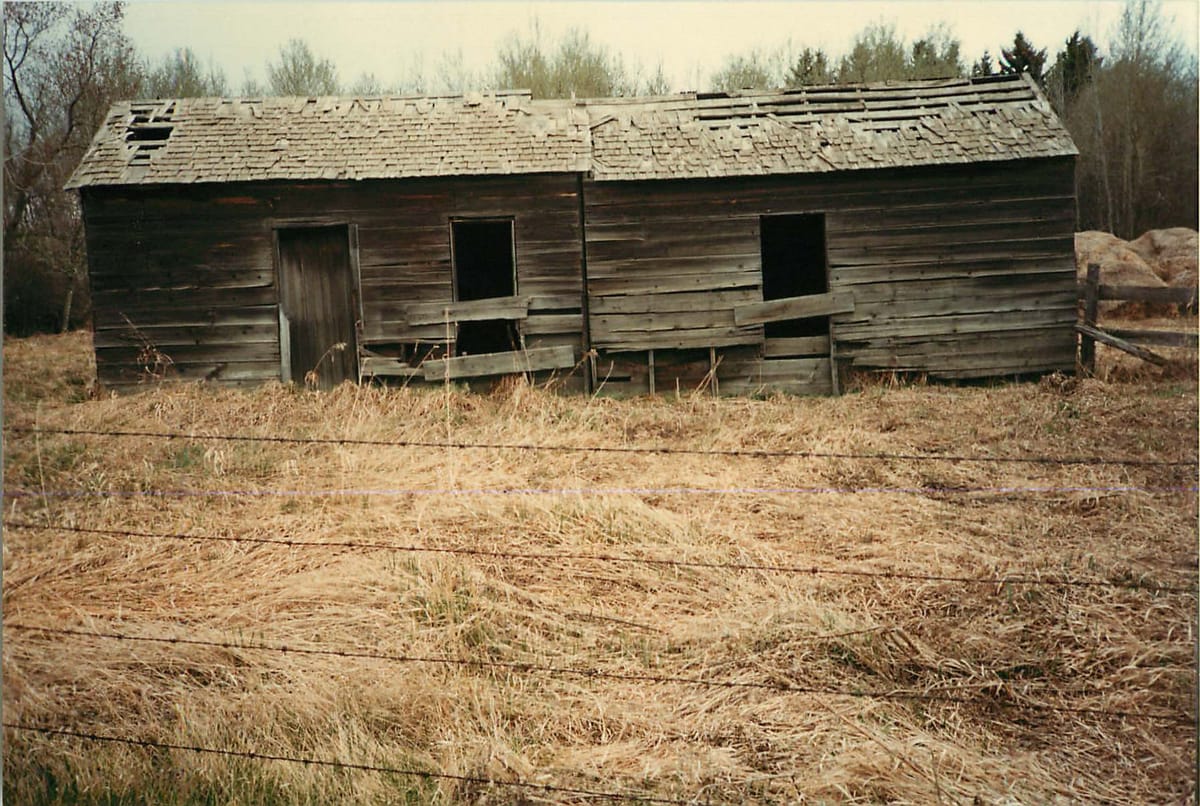
Our family history is not settled on why my grandparents left Switzerland. Was it social and political strains between the German and French-speaking factions in Switzerland at the end of World War 1, was it perceived opportunities to own land and to prosper in western Canada, or was it the pull of earlier immigrants who had settled here? My grandmother left a home in Switzerland with running water, central heating and electricity and upon arrival in Alberta, moved into two granaries (the photo at the top of this post) my grandfather had pushed together on his land, with a hand-pumped well and kerosene lamps, for the family of 6 to live in. And they arrived only a year or two before the start of the Great Depression. Not great timing.
Even if we can't know why this family, and so many others like them, came to Canada, we can understand why Canada wanted (needed) immigrants. They strengthened our territorial claims, as immigrants became citizens and had children who were citizens. Immigration supplemented our relatively low birth rate. Population growth fueled our economic growth, providing increased demand for land and goods and services, and that economic growth benefitted everyone. Outside of the urban centres, Canada was sparsely populated, and in many ways still is.
Immigrants will be an important source of tax revenue to fund future social programs and pensions as they supplement or drive our population growth. But instead of being predominately white and Christian coming here to farm, as they were in the 19th and 20th century, they now represent a vast range of races and ethnicities, religions, languages and cultures coming to work in a wide range of vocations and industries.
Our lives, personally, have been greatly enriched by our introduction to the food, values, customs and beliefs of the immigrants in our community. Besides economic growth they bring aspects of their lives and homes and world that they share and from which we learn. The belief that these new immigrants arrive and promptly qualify for, apply for and receive public assistance at the expense of the Canadian taxpayer (whether funded by the federal or provincial governments, there is only one taxpayer) is mistaken. It wasn't true in 1925 when my grandfather arrived and it isn't true today. Immigrants work hard, take enormous risks, forsake extended families and their histories to try to find prosperity, or at least opportunity and safety. Their courage and their dreams and their challenges are very similar to those faced by my grandparents 100 years ago, except that now we have indoor plumbing and high-speed internet.
So the next time your elected representative uses your own tax dollars to tell you that the reason houses cost so much, or the reason that 7% of our population is unemployed is because of immigrants admitted by the government of Canada, and that the solution is a system of provincial immigration "permits," ask some hard questions. Who is going to staff our nursing homes and care facilities, difficult low-paying work? Who is going to pick the fruit in B.C.? Who is going to staff the fast food restaurants, clean your hotel rooms or, for that matter, provide your primary health care? And more importantly, who is going to pay the taxes we need to fund our pensions and future care? The government of Alberta would like you to believe that we will be better off if we limit immigration. That with our new immigration barriers we will save enough on reduced social program spending to pay for the bureaucracy we will have to create to administer the immigration permit system. Really? Put me down as highly skeptical.
Alberta's governing politicians seem to think that if we could only control immigration locally, we would be better off economically, socially and culturally. Not very likely. Canada attracts immigrants because of its stability, its tolerance, its opportunity and its values. This country accepted our ancestors, but the tolerance and welcoming attitude they found is slipping away. It's being pushed out the door by our own government, scrambling to find an election issue that can distract us from the dumpster fire they have created out of our health care system. Classic misdirection - don't fall for it.