My Next Book

That best of days: you've just finished a book and now you get to choose a new one to read. How do you decide which book? For a few months now I have been thinking about how, exactly, I come to read the books I choose - how did they come to my attention, and then find their way to my nightstand? I've learned that my books come from 6 sources. In descending order:
- Reviews;
- Favourite Authors, or series entries;
- Friends and Family;
- Bookstore Shelves, displays;
- Classics, or Ought to be Read;
- Re-Reads; books I've loved, and need to read again.
Reviews are found mostly in newspapers, but occasionally in other sorts of publications or programs like magazines, CBC or NPR. A new book by favoured authors like Ann Patchett or Elizabeth Strout or Mick Herron would automatically get added to my TBR (To Be Read) list. Janet is the most frequent name on the Friends and Family list because a) she reads almost twice as many books as I do, and b) we talk about books most days. But other reading friends are well represented (here I thank Diane, Scott, Alastair, Bob, Charlie and Gillian, to name but 6, not to mention Sean and Laura and Blair, who all read more widely than me).
I re-read 3 books over the past 3 years, and there is one re-read in my TBR pile right now. That's not very many. "Bookstore Shelves" - books you pick up at the bookstore to look at, and end up buying - are a testament to the skill of the book designers and marketing geniuses, those who create the cover and the descriptions and displays that draw you in.
The Classics are seminal books that I have the feeling I ought to read if I want to be a better person. Jane Austen and James Joyce are not found here, but past reads in this category include books like Heart of Darkness (Joseph Conrad) or East of Eden (John Steinbeck) or Old Man and the Sea (Ernest Hemingway). These aren't always rewarding reads, unless reader smugness or self-satisfaction is a virtue, which I doubt.
For many years I have used Goodreads, an app that helps track what you've read, and what you intend to read. A handful of friends and family are connected to me on this app, which tells me (with their permission) what they are reading and what they want to read. It tells them the same things about me. I have recently started playing with The Story Graph, an app that focuses more on recommendations than on statistics. It hasn't generated anything especially useful yet, but I'm hopeful, in part because it is a UK app rather than American one. More on that aspect later.
My dive into the question of how I decide what to read next started with a podcast called, not surprisingly, "What Should I Read Next?" It has been running for 10 years. I've only listened to 5 or 6 of its 500 episodes, so I've only dipped my toe in. I can say after a very few episodes that there are a lot of extremely well-read, articulate people out there who aren't public figures. One of the best things about this podcast is that you can't help but think about what you like to read, and why.
Although I read a lot of mysteries, and related genres like spy fiction and historical mysteries, I have never been caught up in the sub-genre called "cozy mysteries" which is fronted by an enormously popular and prolific Canadian author (and former CBC presenter) named Louise Penny. I've read a few of them - there are many - and they are OK, but I've not become attached to her protagonist Chief Inspector Armand Gamache of the Sûreté du Québec, or to the location of her stories. Three Pines must statistically be the most dangerous village in Canada, perhaps in the world, judging by the number of people murdered there. But her admirers are legion and well represented on the What Should I Read Next podcast.
One source of recommendations that you won't find on my list is what I call "algorithm recommendations." Goodreads, Kobo, Amazon and others will recommend books to you based on what you've already read or bought, but I rarely find these to be helpful. Or maybe I just mistrust them.
This brings me to the point of this post: I have concluded that my TBR list, and the books I actually read, are badly skewed in two different ways. First, because I tend to add books based on reviews, my TBR list has a lot of new or current releases. There are a few (many) great books from years gone by that got past me without notice. I think of it as a great firehose of new books, from which I'm trying to get a sip, while the lake fills up behind me. Second, because the reviews I do read are often American (the New York Times Book Review has been my primary source for more than 10 years), reviewed books are mostly products of the American publishing industry. Inevitably for these two reasons, most of my TBR list is made of newly released American fiction. International authors, whether writing in English or translated into English, are woefully underrepresented. This doesn't mean I miss authors like Kazuo Ishiguro or Hilary Mantel (English) or Peter Carey or Jane Harper (Australian) or Tana French or Sally Rooney (Irish), but it means that English, Irish or Australian or international translated authors are much harder to find. The list of Man Booker Prize nominees is helpful, but has relatively few titles and depending on the judges, can be way out there.
So what's the answer? My conclusion is that I need to elevate friends and family as recommendation sources and reduce my reliance on reviews. This post is the start of my attempt to go down that path.
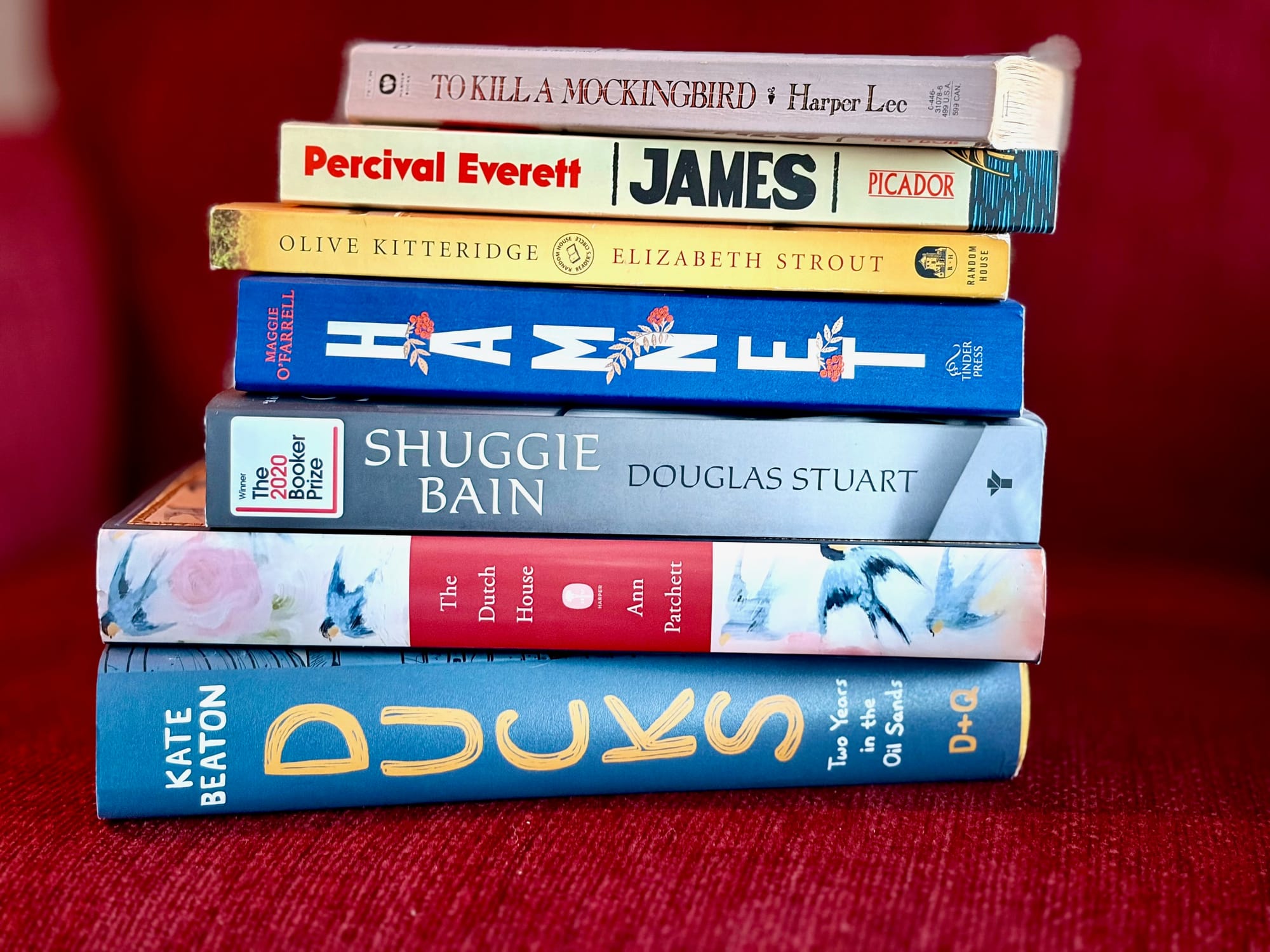
An earlier post - Killing All The Lawyers - In Fiction - generated some great recommendations and observations, which I am still working on. My hope is that this post will encourage you to tell me about books you've loved and why. I will start the ball rolling by listing just a few of the treasures on my list, in no particular order:
- Warlight (Michael Ondaatje) A family mystery set in post-war London. This would fall in a category called "Literary Historical Fiction."
- When We Were Orphans (Kazuo Ishiguro) Also a family mystery, set in London and Shanghai over a lengthy period, ending with the Sino-Japanese war that preceded WWII. I choose to believe that when Ishiguro received the Nobel Prize in Literature, this is the representative book they had in mind.
- The Honourable Schoolboy (John le Carré) To me, the best of all the le Carré novels, set primarily in Hong Kong while it was still a British colony.
- Hamnet (Maggie O'Farrell) My most recent 5 star read. Historical fiction of the highest order.
- The Correspondent (Virginia Evans) By now you've probably heard of this unlikely 2025 best seller, a testament to the beauty and power of the written word. Don't miss it. Like Hamnet, it is not over-hyped.
This list demonstrates my weakness for historical fiction, particularly if there is a mystery or quest of some kind involved. There are many, many books I enjoyed that don't involve historical settings or different geographical locations, but if a book has those elements (A Gentleman In Moscow, for example), I am easy pickings. I will also mention one series I am completely hooked on: the Slough House series by Mick Herron, 9 books beginning with Slow Horses. The TV series (Apple TV+) featuring Gary Oldman as Jackson Lamb is more than worthy, but the books are topical, fast-paced and darkly funny. I have some non-fiction favourites too, but perhaps in another post ...
If you are among those who don't like to leave comments in the blog public space, let me know! I will take your recommendations however they come.