5 Golf Courses You Should Play - Post No. 2
Good health, resources and friends are 3 essentials you need to enjoy some of the best public golf in the world. A patient (or at least tolerant) spouse is another. I will offer some opinions if you’re wondering where to take your game. Opinions about a golf course are influenced by the weather, how well you played that day, the company you played with and countless intangibles like our preference for (or dislike of) the golf course designer, pace of play, treatment in the pro shop and the culture of the place you are in. I will add a few courses that almost made the list and some that I would happily never play again, and wish I hadn’t bothered to play to begin with. The courses on my “skip it” list are renowned and beloved. But not by me.
It is worth noting that all but three of the courses on my must-play and honourable mention list are on or near an ocean, Pinehurst No. 2, Jasper Park Lodge and Wolf Creek in Nevada being exceptions. I think the reason for that lies in the history of golf, which began 500 years ago when the Scots dug holes in the sandy ground which linked the beach to the more fertile ground inland. This links land wasn’t good for much other than grazing sheep. The sheep had to be relocated from the small depressions where they sheltered from the wind, which became the hazards we now call “bunkers.” True links courses, even the modern ones that made my list, recognize and respect this heritage.
Notably absent from this list of courses you should play is the Old Course, in St. Andrews. I have not played it, and decided years ago that I can live a full golf life without playing it. 30 years ago it was accessible, now it is not. I have been to St. Andrews though, my family gamely indulging my passion. We enjoyed the unique and charming atmosphere of the town. If you get the chance, I strongly recommend that you visit the 12th century St. Andrews Cathedral ruins not far from the first tee. At the burying grounds adjacent to the cathedral you will find the plaque marking the death of St. Andrews native Young Tom Morris, who died at the age of 24. He had already won the Open Championship 3 times in a row, but died just months after his wife and infant child died during childbirth. He remains the youngest person ever to win the Open. The inscription on the plaque marking his death was written by a local poet:
“Deeply regretted by numerous friends and all golfers, he thrice in succession won the Championship belt and held it without envy, his many amiable qualities being no less acknowledged than his golfing achievements.”
We should all hope to be remembered more for our amiable qualities than our golfing achievements. The R & A Museum is adjacent to the first tee and the 18th green of the Old Course and is well worth the stop. Golf history of the best kind.
Here’s my list:
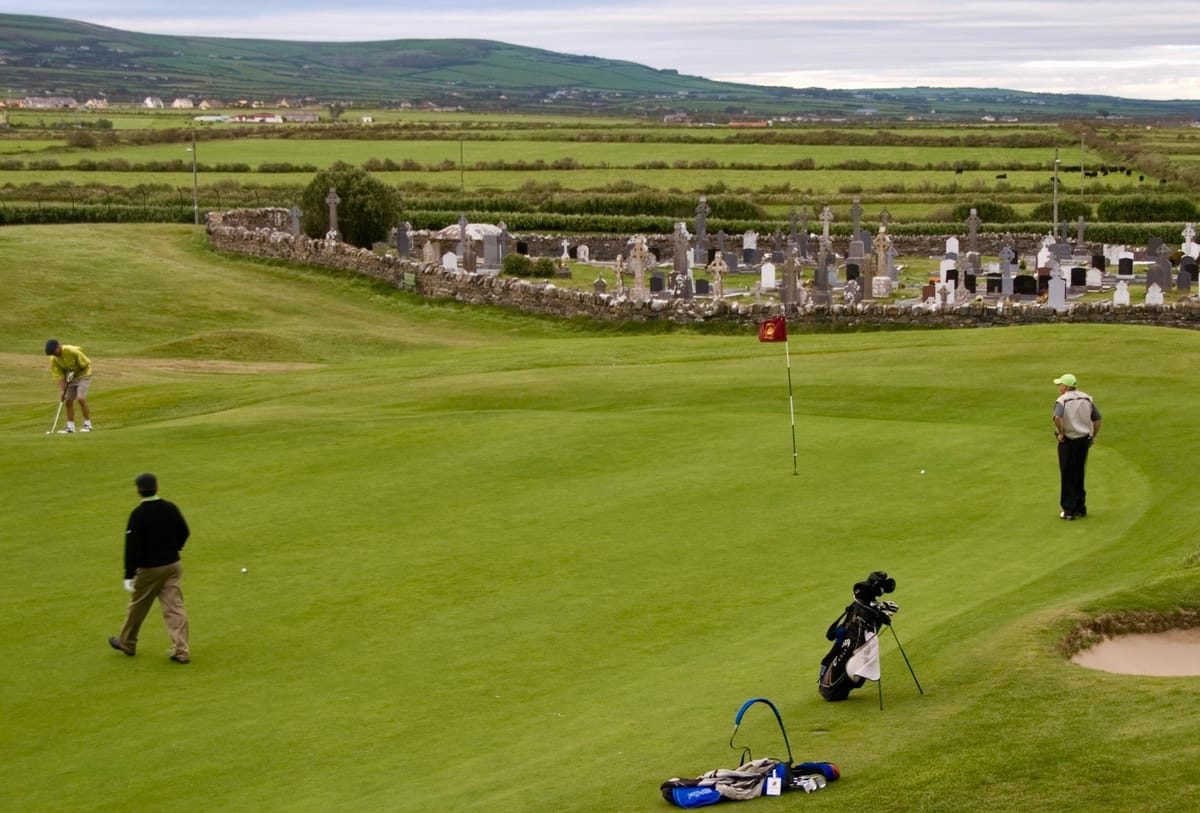
5. Lahinch (and almost Prestwick). To say that they don’t build courses like this anymore goes part of the way towards explaining my affection for these two entries. The sheer joy of playing them takes us the rest of the way to the number 5 spot. Lahinch (in Ireland) slightly edges out Prestwick (in Scotland) for the fifth spot because of its expansive sea views. Both were designed – if that’s the right word (laid out might be better) – by Old Tom Morris, Young Tom’s father, and both are quirky, with blind shots that are now out of favour. Lahinch was later rebuilt by Alistair MacKenzie, who went on to design both Augusta National and Cypress Point. It has pretty good bones.
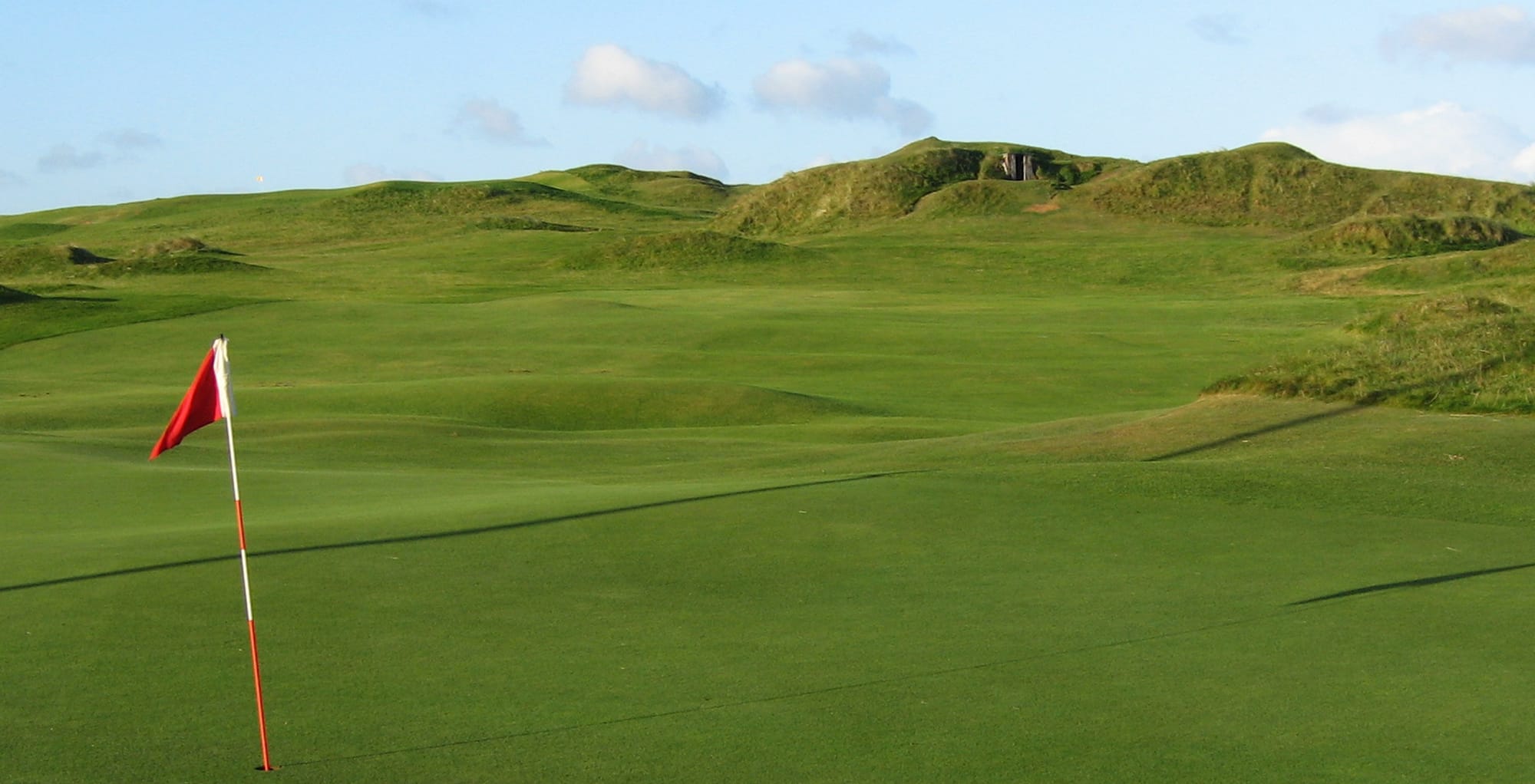
The fourth hole at Lahinch (called Klondyke) is certain to be among the most memorable you will play, ever. It is a short par 5, the drive down a chute between sand hills on either side. Your second (or maybe third) shot must be played over another enormous sand hill that crosses directly in front of you, through the fairway. Playing without caddies that day (our first mistake) and seeing no clear way to go around this monster, I decided to clamber up to the top (mistake number two) to see what was on the other side. I stumbled on a hut tucked into the far side of the hill (see photo below), where there sat a startled spotter, just as surprised to see me as I was to see him. His job was to raise the all-clear flag when it was safe to play over the hill. This task was complicated by the fact that another fairway crossed directly through the fourth fairway on the blind side of the hill. I don’t remember what I made there, but it wasn’t par and it didn’t matter. This was followed immediately by the par 3 fifth hole (Dell), with its green completely enclosed by hills. It plays just 143 yards, a number you had to accept on faith, as the flag is hidden behind the hills and there was no other way to figure it out in pre-GPS days. Two holes with blind shots, back to back! If this exists anywhere else in the golfing world, I’ve not seen it.
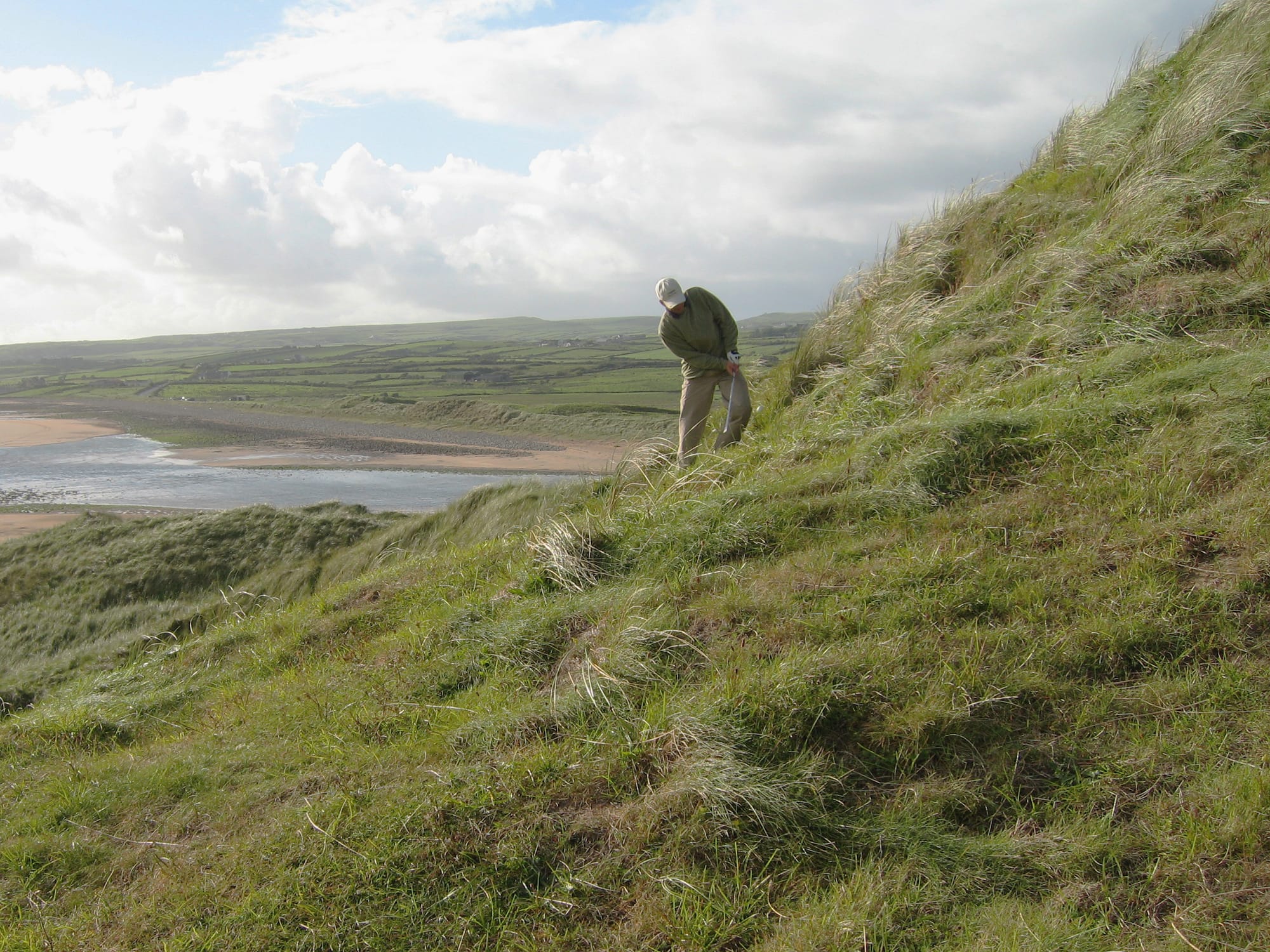
Caddies are a must here, and at all the courses on my list, for a variety of reasons. Playing Lahinch the first time we climbed up to an elevated tee after 6 or 7 holes to find our next teeing ground – and could not decide whether to hit to the left from the tee markers, or to turn 180 degrees and hit to the right. There were no clues to suggest the direction of the next fairway – it was blind in both directions, no other tee boxes visible. We guessed. Irish and Scottish caddies are properly famous for finding any ball, anywhere. No small feat in the knee-high grass (see below) that is truly “rough.” They are also famously taciturn. My friend Alastair hit a somewhat indifferent tee shot up into the wind, and it drifted well into the rough, doomed. There was a moment of awkward silence while we waited for Alastair’s caddie to assure him that his ball would be found. All 4 of us turned to his caddie, still waiting. “Aye” he said, realizing he had to say something. “That’s not good.” Do not go to Ireland expecting false hope.
4. Royal Portrush. Added to the rota of British Open courses in 2019, this Northern Ireland course (you don’t have “Royal” golf courses in the republic of Ireland, for obvious reasons) is a spectacular brute. We played it in a stiff wind with skidding grey clouds, an average day, getting full measure of its charms and punishments. It features treacherous, beautiful, interesting and mean holes, one after the other, with vistas of the sea for much of the round. It deserves its reputation. On this day Alastair’s caddie was a middle-aged Irishman who seemed remarkably well travelled by caddie standards, and whose advice was unusually specific and spectacularly useful. The other caddies in the group deferred to his green reading and were not to tell players that he had for years been a tour caddie for Darren Clark, the most accomplished Portrush golfer not named Rory McIlroy. Another reason to use a caddie.
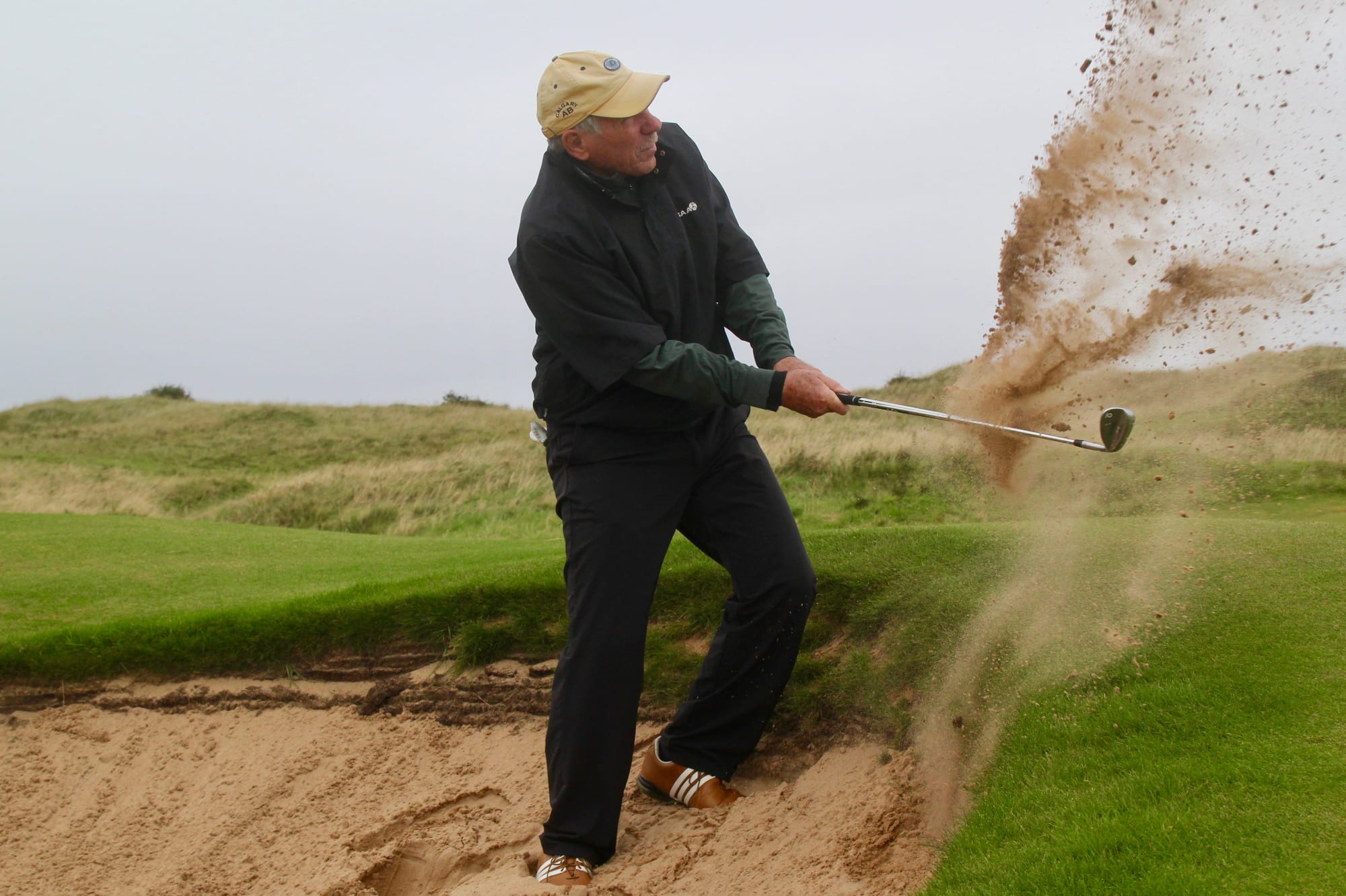
3. Pinehurst No. 2. There are 8 golf courses at the Pinehurst resort in North Carolina, and we enjoyed others, but there is nothing the equal of No. 2. Our caddie that day took us from the range to the chipping green to practice before our round, for good reason. The greens are small and crowned, making chipping critical to your day. There are no cart paths to be seen; it’s like playing in a golf museum, untouched since it was built. In fact, it was recently restored by Ben Crenshaw’s design team for modern distances, but it retains the feel of a 125 year old golf course, designed to be walked and not to help sell McMansion home sites. The hospitality available at the resort is comparable only to that found at Bandon Dunes.
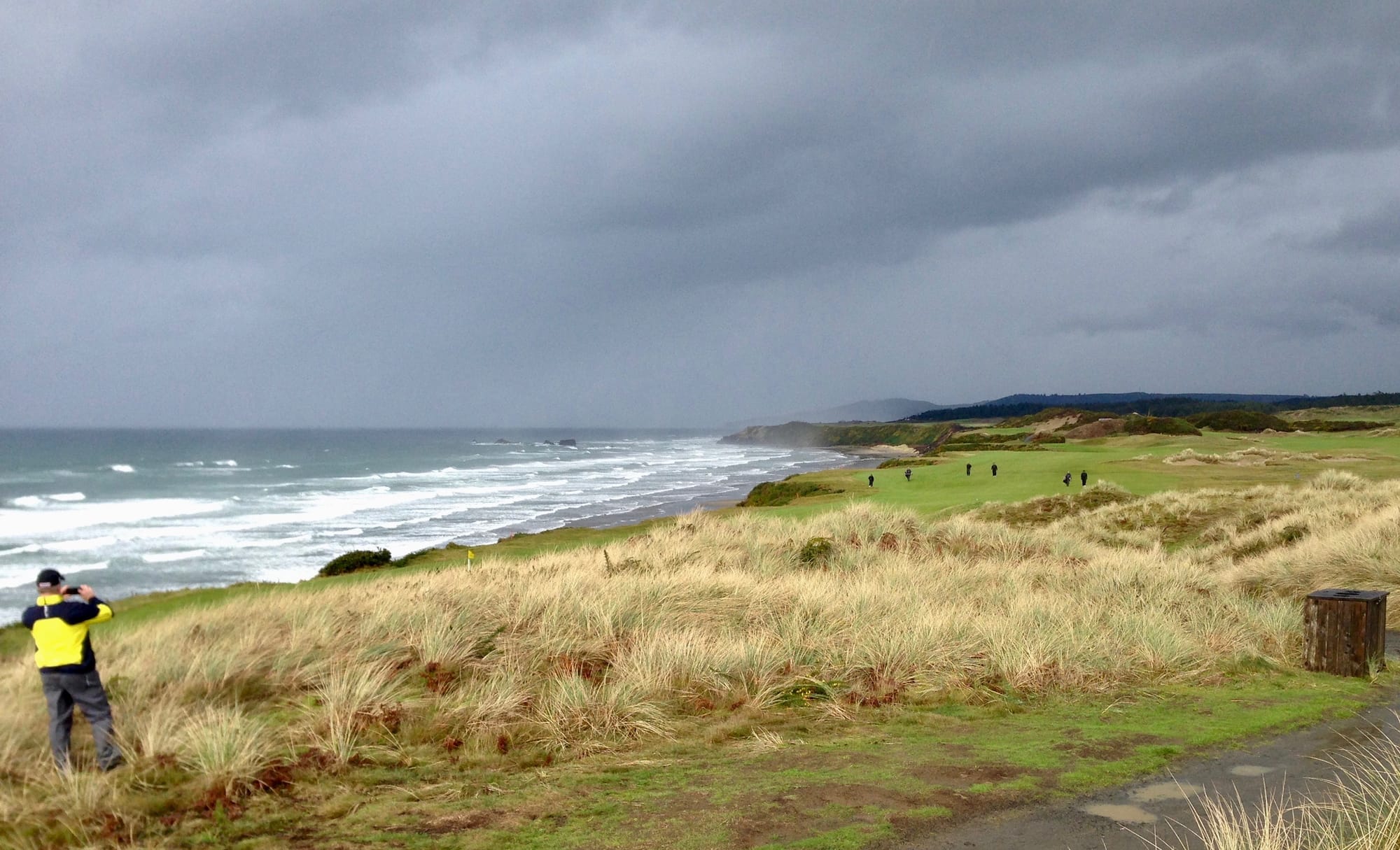
2. Pacific Dunes. This is the second course built at Bandon Dunes on the Oregon coast, where there are now 6 courses. It is a Tom Doak design that I prefer to the original Bandon Dunes course. Doak has mixed interesting holes with rugged, memorable holes, nothing wasted, making best use of a spectacular piece of ocean property. Bandon Dunes is remote and costly, but it delivers: great food, great accommodation, good service and memorable golf experiences. From the Punchbowl putting green (100,000 square feet of rolling green) to the 13-hole par 3 course (the Preserve, great fun) to the range (also massive, with its own 9 hole par 3 warm up loop, Shorty’s), there is lots of golfing to do when you’re not on a course. After Pacific Dunes my Bandon preference is Old Macdonald, another Doak design. It is quite exposed and most lists rank the original Bandon Dunes course ahead of it, but it has 4 or 5 truly memorable holes. Put Pacific Dunes on your must-play list. It is consistently ranked among the top 5 courses in the US, and the resort is up to that standard. Go with friends, and make time for Old Macdonald. But be warned, most of the courses are designed for the prevailing summer winds, which blow from the north. On one occasion, a fall trip, we played Pacific Dunes in a south wind, which made some of the par 4’s play very short and others play very, very long.
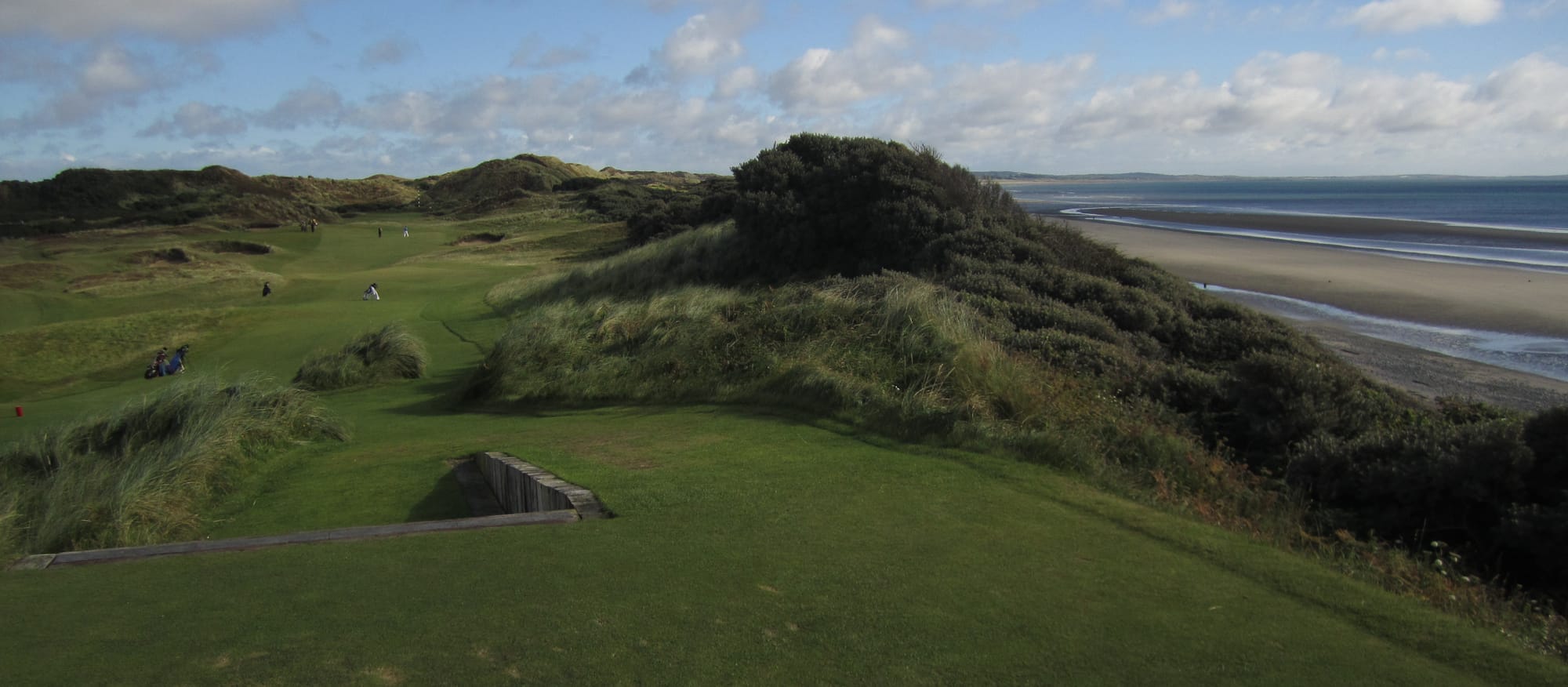
1. Royal County Down. This Northern Ireland course is not far from Dublin, and it is often ranked as the best golf course in the world, never out of the Top 10. We arrived with very high expectations, and even those were exceeded. It is a stunningly beautiful golf course in a lovely seaside resort town (somewhat novel for Ireland) with some of the best accommodation we found in the country. This is a public course, but tee times are scarce, making use of a tour packager to get your times essential. The original course was laid out by Old Tom Morris (a busy fellow in those days – he was also a club pro, greenskeeper and a professional tournament golfer) and it takes your breath away, hole after stunning hole. There is the mandatory blind tee shot, where your caddie leaves you to run ahead to the top of the sand hill to show you the left edge of the fairway you’re aiming for. His job is to spot your ball as it (hopefully) sails past him. Our spotter seemed unperturbed when one of our group pulled his tee shot, which went sailing behind him, in a direction he definitely wasn’t looking.
So why is this course number 1? Beauty, history, conditioning, brilliant design, in an interesting place. There really is no place like it in the golf world. You might not get back there a second time, but you will always be intending to.
Honourable Mention
Some courses that didn’t quite make the top 5 list:
Cabot Cliffs (Nova Scotia). Striking seaside holes, interesting Crenshaw/Coors design. The resort is not Bandon calibre, nor are the courses quite Bandon quality, but it is the best links-style course in Canada.
Jasper Park Lodge (Alberta). An old Stanley Thompson design that has stood the test of time. It is not always as well-conditioned as the cost would suggest, but no one frames the views like Thompson did. The Highland Links course in Cape Breton, Nova Scotia is similarly not well-maintained, nor as scenic as Jasper Park, but both are unmistakably Thompson courses.
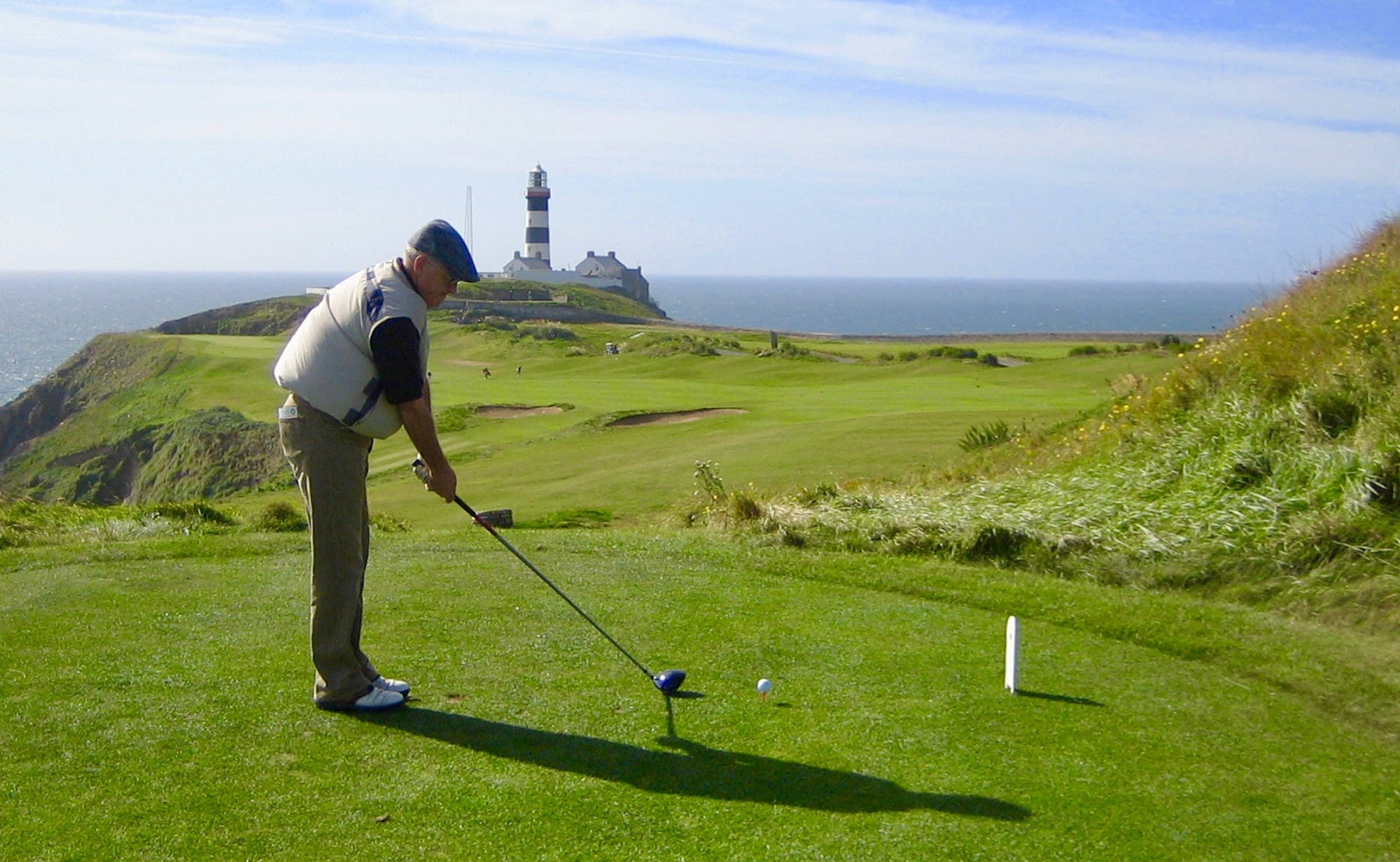
Old Head (Ireland). This is a new golf course (by Irish standards) built on the headlands not far from Cork. And by “on the headlands,” I mean 18 holes that run along cliffs 200 feet above the ocean crashing below. We played in a 4 club wind that comes from all 16 points on the compass as you move through the holes. Up- or down-wind was simple. Crosswinds were impossibly challenging. Visually the most intimidating, if not plain scary golf course I’ve ever seen – the green on the hole pictured below is on the edge of cliff over Scott’s back. There is no more than 3 feet from the edge of the green to the drop, not even room enough for a fence. Favour the right side. The Wolf Creek course in Mesquite, Nevada is a close second for visual impact, but it is routed through a red rock canyon and not along the top of a cliff above the Atlantic Ocean. Wolf Creek is amazing to look at and fun to play, but not quite as intimidating as Old Head.
Royal Troon. A classic Scottish links course, also an Open venue. Beautiful views across the links to the ocean, it is what I think of when I think of links golf. It is also a friendly place, unexpectedly, quite unlike Ballybunion in Ireland, which is another great links golf course. I found Ballybunion to be quite stuffy and unwelcoming, unusual for the Irish. After our round at Troon my friend Bob and I asked to be seated in the dining room for lunch, which has a gorgeous view of the 18th green and the course beyond. Bob slipped off to the pro shop and I was shown to a table right at the window, the sun streaming in. The dining room was quiet, but for a table of 4 distinguished looking gents wearing matching navy blazers and ties, whom I took to be elderly members. They watched me be seated at my table, wearing my golf clothes and wishing Bob would arrive from the pro shop, not certain I had not been mistakenly seated in the wrong dining room. After a few moments one of the gentlemen waved the hostess over, and I was sure I was about to be politely relocated to the tourist’s cafeteria. “Miss” he said “Could you please lower that shade for our friend by the window?” He looked over at me a bit sheepishly. “We don’t get much sun here.”
Miss Them If You Can
Pebble Beach: 12 muni-calibre holes and 6 magnificent holes, but priced as if demand is bottomless and they’re 18 masterpieces. Unless you are playing it when it is prepping for a tournament, the course conditioning is disappointing. At this price point, theft. Play Spyglass instead.
Banff Springs: Another classic Stanley Thompson design, but ruined by a decision to add 9 more holes, change the routing and mix in holes that aren’t up to Thompson’s standard. An unfortunate waste of water and fertilizer.
Bandon Trails: For my money, you can skip the Bandon Trails course - it is a parkland course that you can play anywhere. It doesn’t benefit from the seaside location. Opinions vary, and some rank it ahead of the Old Macdonald course. I don’t.
The Ocean Course at Kiawah Island and PGA West in La Quinta: These are both Pete Dye courses, and I should stop right there because he’s dead and there’s no need to stop him from designing again. These courses are not designed for enjoyment, they are intended to annoy tour players and demonstrate to the rest of us that we are not tour players. We knew that already. They are the absolute opposite of the courses of Old Tom Morris, which are organic in their use of land and fun to play. Old Tom would not have had much to say to Mr. Dye had they met, because they spoke completely different design languages. Where would Pete Dye be without railway ties, those critical golf course design aids? Old Tom left them under the train tracks where they belong.
And as a final thought, a list of courses I haven’t played, but wish I had, and might yet:
Royal Dornach (Scotland), Whistling Straights (Wisconsin), Chambers Bay (Washington), Cruden Bay (Scotland), Sheep Ranch (Oregon). Augusta National and Cypress Point (kidding).