Why We Sing Along - Post No. 4
Many years ago (40 or more) a Charlie Daniels song came on the radio as I was driving. Blair was strapped into his car seat in the back, 2 or 3 years old. I heard Blair singing the words describing a fiddling contest between Johnny and the Devil taking place in Georgia, even though he (Blair) was just learning to talk. From this I learned two things: children hear EVERYTHING, whether intended for them or not, and some music must be sung along with, no matter your age or musical tastes. Blair was not scarred by this early exposure to early '80s pop country music, or for that matter the odd yodelling or bluegrass song; he grew up to be an adult of exceptionally wide musical tastes.
Music - creating it and listening to it - is found in literally every culture in the world, and has been found by archeologists and anthropologists to have existed for thousands of years. But it is only in the past 100 years so, with the invention of means of recording and playing back music, affordable to most, that it has become a force of cultural change and a marker of cultural identity. For many of us, the experience of hearing a song we listened to and loved when we were young - as children or teenagers particularly, brings back strong memories of the times when those songs became known to us. Songs can be sentimental or powerful, they can inform or enlighten, they can be silly or profound. No matter the kind of music, given the right circumstances when we hear them, we will remember them.
The noted writer and neurologist Oliver Sacks (1933 - 2015) wrote of our memories of music in his 2007 book Musicophila: Tales of Music and the Brain. He concluded based on both research reports and clinical observations (forgive the gross simplification of his careful and precise conclusions - he was a scientist, I am not) that our memories of music are stored in different parts of the brain than our memories of experiences, or facts, or even language. We can recall and enjoy familiar music, and enjoy new music, even if our minds have been devastated by dementia or Alzheimer's, even if we have no understanding of who we are, or our history. Dr. Sacks found that "... musical perception, musical sensibility, musical emotion, and musical memory can survive long after other forms of memory have disappeared."
I mention this because it goes some way towards explaining why music matters to us - it can remind us of something from our past, and it meets some subconscious need for rhythm, for pleasing combinations of sounds, tones, and words. And often, if the music we are enjoying, or remembering, has words, we sing along, with greater or lesser degrees of skill. Sometimes we sing alone (the shower is a known venue, the car is another) and sometimes we sing with others (church being a frequent venue for this form of singing, concerts another).
For most people, there are certain performers and songs that are so pleasing, so central to our lives, that they are easily recalled and continually enjoyed. If you were born or grew up in the late 1950's or early 1960's, the music of the Beatles, or Bob Dylan and a hundred other artists is lodged in your brain. And when you hear those songs, you can be moved to sing along.
In my concert-going life I have been fortunate to have had the chance to sing along, in person, with more than a few of my musical idols. I've sung "Fire and Rain" with James Taylor, "Brown-Eyed Girl" with Van Morrison, "Four Strong Winds" with Ian Tyson, "Bennie and the Jets" with Elton John and "Wondering Where the Lions Are" with Bruce Cockburn. The list of performers who have let me sing with them is long and treasured: John Prine, Nanci Griffith, Jackson Browne, Jesse Winchester, David Francey, and many more, some now gone. None of these performers were particularly aware of my singing with them, other than in a general sense since most of the audience was also singing. Two of them, Ian Tyson and Van Morrison, were at that stage of their lives famously irascible and would clearly have preferred that we not sing along.
Other cherished performers demanded that you sing along: Stan Rogers, with whom I sang on 5 different occasions in Alberta and Saskatchewan before his death in 1982, would not permit the audience to merely watch and listen. To him, music was a group activity that he happened to lead, and songs like Northwest Passage and Barrett's Privateers were written specifically for him to do that. I recently listened to a recording of Ian & Sylvia performing Four Strong Winds at the Newport Folk Festival in 1965, and there was Tyson inviting the audience to sing along! I was astonished; that was certainly not my experience of the man.
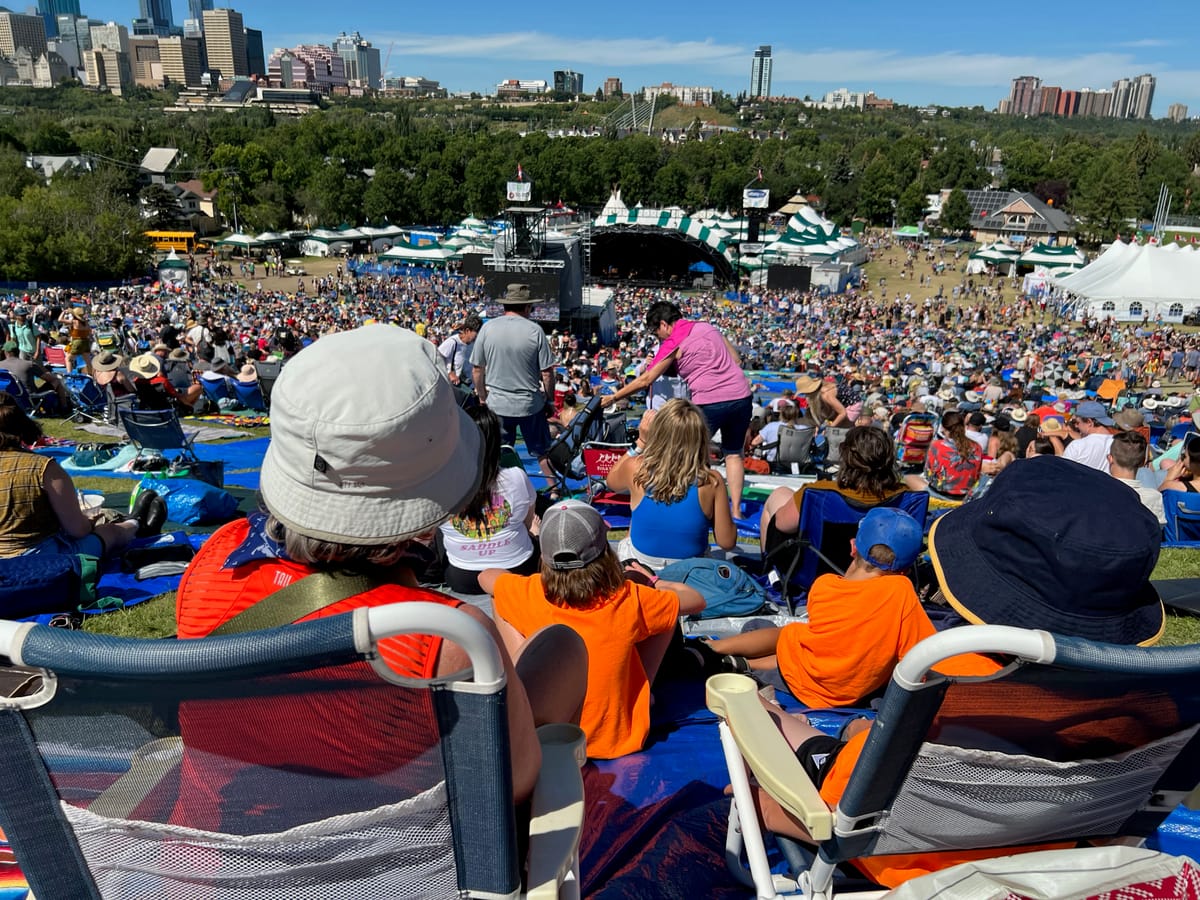
Also notable in the category of performers who insist on audience singing is Brandi Carlille. On two different occasions where we were in the audience (one with an audience of a couple of thousand at the Winspear in Edmonton, another with an audience of more than 15,000 people on the hill at the Edmonton Folk Music Festival) she divided the audience into 3 different sections. One section (the lucky ones) was to sing the melody with her and the other two sections were to sing harmonies with her two long-time bandmates, the Hanseroth twins, Phil and Tim, high and low. That was pretty ambitious for most of us, but the results were truly beautiful to be surrounded by - the stuff of which memorable performances are made. You can hear a recorded version of the song (Turpentine) on her 2011 live recording "Live at Benaroya Hall, Seattle WA." The singing begins when Carlille says, partway through the song "OK! Here's what we're gonna do ..." This was not a negotiation, or even a request.
So what is it about singing as a group that is so satisfying? For accomplished choral singers, the sound of beautifully arranged and performed vocal music, the blending of skilled voices, is its own reward. Our son Sean experienced this in exceptionally skilled high school and university choirs he was a member of. We got to hear this when other parents were going to and from hockey and ringette rinks. For many people the act of singing hymns and other inspirational songs in church is comforting and uplifting, their familiarity in a setting of community part of a way of life. But group singing happens in other settings too: my wife has great fondness for her outdoor aquatic exercise classes which are accompanied by music that often triggers the entire to class to sing along, loudly and enthusiastically, while exercising. In water - deep water. The music, familiar and loved by the group, must be sung to regardless of the danger. So it is partly the music, partly the setting, and partly our own emotions.
Oliver Sacks speaks of this as being true for most of us: "We bond when we sing together, sharing the specific affects and connections of a song." He believes the bonding to be even deeper "if we dance together, coordinating our bodies and not just our voices." However dancing and singing communally may be a bond too far for some, beyond our abilities and constrained by our inhibitions.
On a couple of occasions I have been part of an audience that was singing with great affection songs that I had never heard before, but that were obviously loved by most of those in the audience (coincidentally they were two Texas singer/songwriters, Guy Clark and Don Williams). It is a fact of life: people are going to sing, whether you join with them or not and whether you want them to or not. The question of why is beyond rational explanation. We sing because we want to, or because we must. Good singers or not, we sing.
So don't overthink it (as I obviously have). If you hear the song and feel the music, as the saying goes, sing like no one is listening.