Breaking Up Is Hard To Do - Post No. 23
Leaving Vancouver on our first trip to the US since we left California last November, we were focused on the questions that might be asked by the US Customs and Immigration officer on our way to Alaska. As it turned out, those concerns were baseless - in the past 20 years we have never been asked fewer questions at Immigration. Like none. Zero. Not where we were going, purpose of our trip or when we were leaving. Nothing. Facial recognition technology apparently could not (yet) determine our opinion of the Orange One, but it could establish our general suitabilty for entry. A similar experience awaited us at the Air Canada gate to board our flight - no boarding pass, no ID required, just a camera taking a photo that seemed to connect to everything they needed to know about us. All of this the result, I guess, of their scan of our passports. Sometime in the last 10 months, the world has changed.
Just minutes after leaving the Anchorage airport, driving into the city, we came up behind an SUV with two stickers in its back window. Both were superimposed over American flags; one read "We Are Charlie Kirk." The other had a picture of an AK47 semi-automatic weapon underneath the words "Black Rifles Matter." It took me a while to process those opinions. We were not in the relatively prosperous, benign and progressive comfort of southern California anymore.
As it turned out, that early sighting was a one-off, and I was mindful of the fact that of the hundreds of vehicles we saw in our 18 hours in Anchorage, only that one displayed such unambiguous thoughts. There must, surely, be articulate and thoughtful Alaskans who disagreed with the late and polarizing Mr. Kirk, and who do not believe that ownership of weapons of war is constitutionally guaranteed for all, and of greater importance than the lives of black Americans. But perhaps in Anchorage, those people were more circumspect.
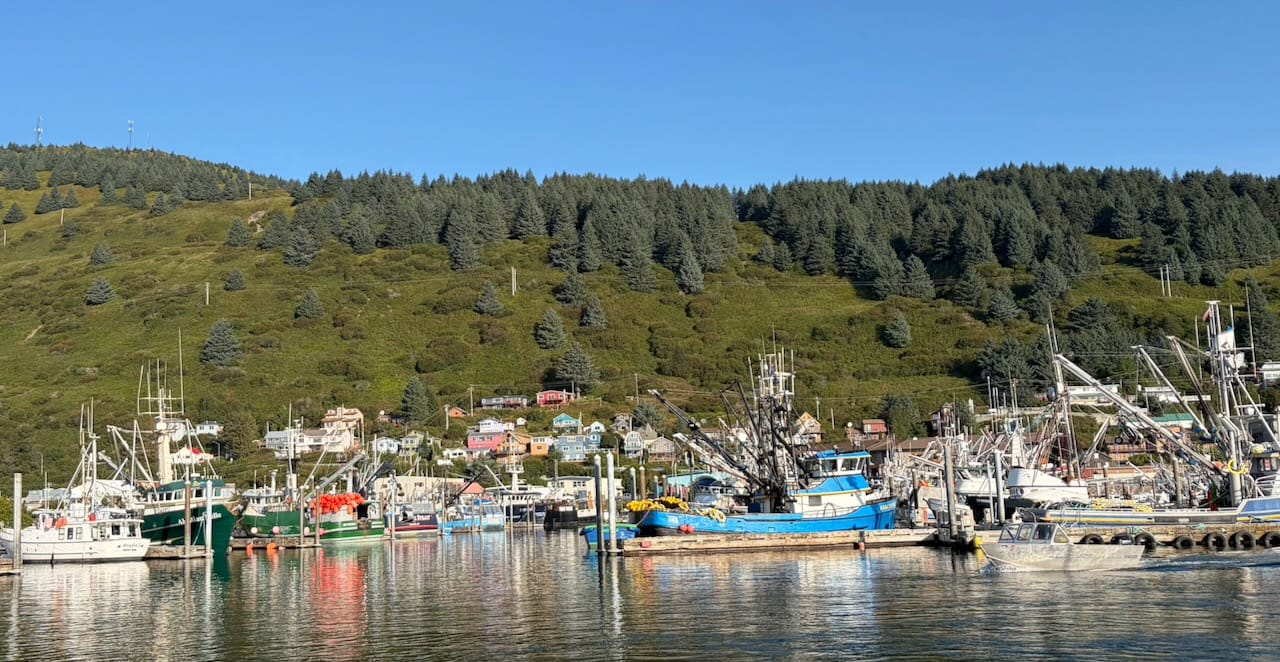
People have long travelled for pleasure to places where the political or cultural reality is offensive or difficult. From Myanmar to China to Turkey, from eastern Europe to Brazil and the Middle East, we travel places where repressive political regimes, abysmal human rights records and economic abuses exist, or recently did. Not that we've been to these places, or that I am suggesting that the US belongs among these nations. My point is that we learn more by seeing these places first hand, and meeting people who live there, than we do by reading someone else's impression of their collective beliefs and history. Alaska is, by any measure, a beautiful if rugged place, and its people, or at least those few we met, are well suited to the geography they live in. Like many Americans living in rural Oregon or Idaho or Ohio or the Appalachias, their politics are at least in part a product of their geography. That's not an excuse, only a part of an explanation. Along the way we learned about how Alaska became an American state and not a Canadian province or territory: Alaska was purchased by the US from Russia in 1896 for $7.2 million. Russia didn't want to sell it to Canada because they didn't want a close ally of Britain, their chief geopolitical rival, to control a territory so near to the Russian coast. This explained - to me at least - something about Alaska's character.
By sheer coincidence we met and enjoyed a couple of meals with a couple from Memphis, Tennessee, a deeply Republican state. As often happens, the very first thing they did was to disassociate themselves from Trump's various insults and assaults on our Canadian economy and sovereignty. Over the course of a few hours we covered the usual topics: health care, personal security, the politics of division, the racial history of the American South. Their views were at least moderate, what in the US would be called progressive. They live in one of the few Democratic districts in Tennessee, which, predictably, the Republican majority was trying to eliminate by dividing it up among surrounding rural Republican districts. This is a fair representation of the race-based gerrymandering encouraged by the US Supreme Court that simply has no equivalent in Canada.
In our typically Canadian way we are in the process of breaking up with the US, quietly, with dignity and restraint and without bluster or fist-shaking (Doug Ford excepted). The US has proven itself to be, as a nation, unreliable and uninterested in alliances. Their glaring weaknesses and intransigence make them unsuitable for a long-term relationship, even though we have a long and more or less beneficial shared history. This doesn't mean that there are not many millions of thoughtful, reliable and moral Americans we can be friends with. But it means that we must start to look elsewhere to secure our economic, social and political future. Even though we have many fundamental disagreements with China, for example, at this point they are considerably less likely to attempt to annex us or crush us economically for their own purposes than our historical "allies."
It is time for us to move on from what has become a toxic relationship, one not likely to be salvaged by the 2028 presidential election. The decay runs deep. Carry on, Prime Minister.