Scotland Once More - Post No. 25
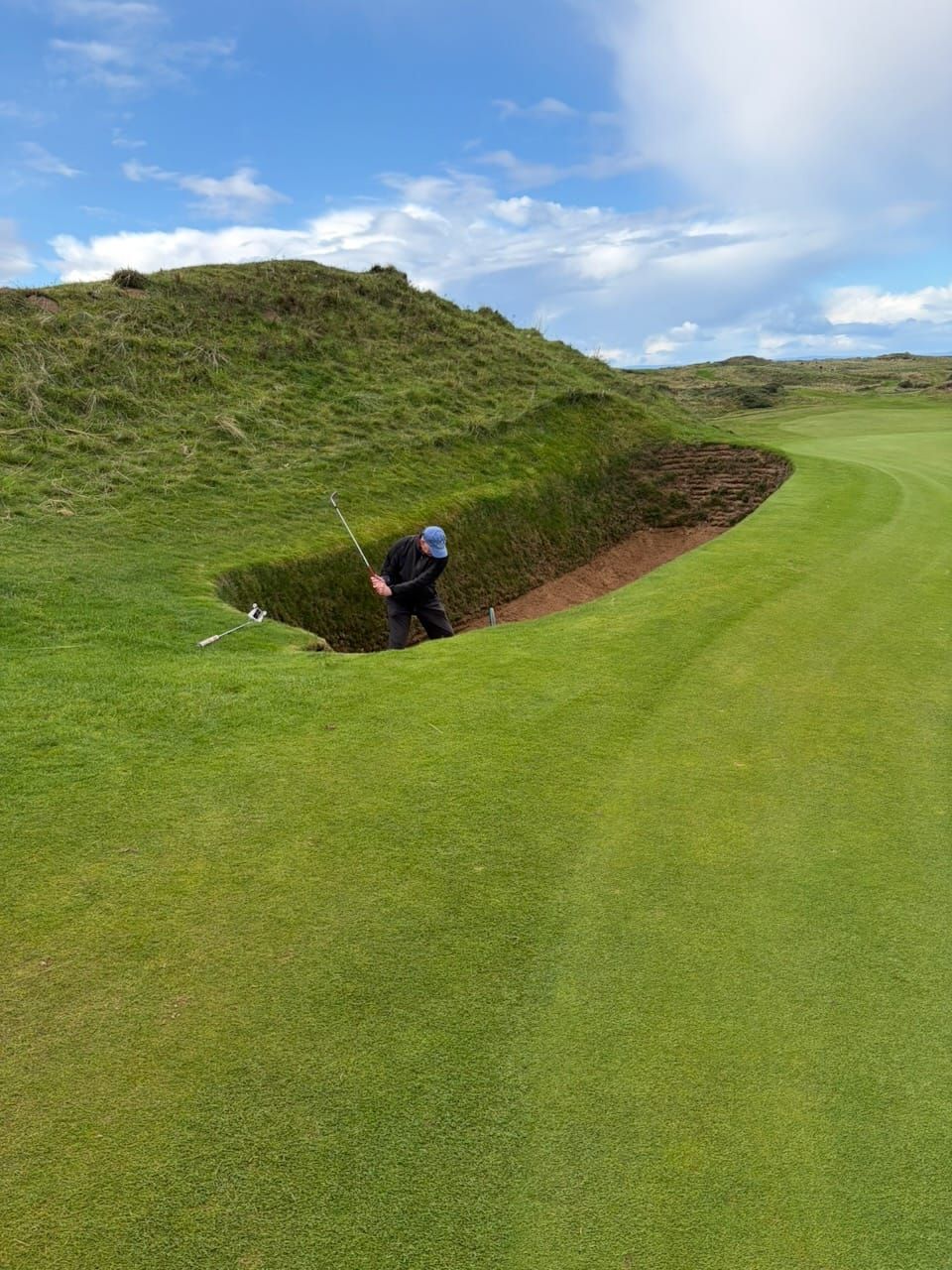
Some time ago I wrote about 5 courses every golfer would be fortunate to play (Post No. 2 - 5 Courses You Should Play) . Having just returned from a recent golf trip to Scotland, I wish to reconsider my recommendations. With 3 friends with whom I have played many rounds over many years, I played 3 courses I had played before (Prestwick, Royal Troon and North Berwick) and 2 courses I had not, but had long wanted to (Machrihanish and Western Gailes). Machrihanish was strongly advocated for by my friend Scott, who had played it years ago rated it very highly. He is only occasionally wrong about such things.
As is relatively common in Scotland and Ireland, our trip was beset by weather, which ranged from unpleasant to miserable to unplayable, on one hand, to implausibly dead calm and nearly warm on the other. Our first day the wind was howling and the rain was blowing horizontally, and one half of the group (my half) opted to stay indoors while the other two went out to play. The very next day, the weather was sunny, winds were light and we came very close to playing in shirt sleeves. This was on the Kintyre peninsula, a piece of land sticking out into the ocean that is two ferry rides and several hours drive southwest of Glasgow. Paul McCartney immortalized the place when he wrote and recorded the song "Mull of Kintyre" which you'll recall featured, naturally, bagpipes. With the least amount of research possible I learned that a mull is a small round hill, in this case one that is very near to the golf course we had come all this way to play.
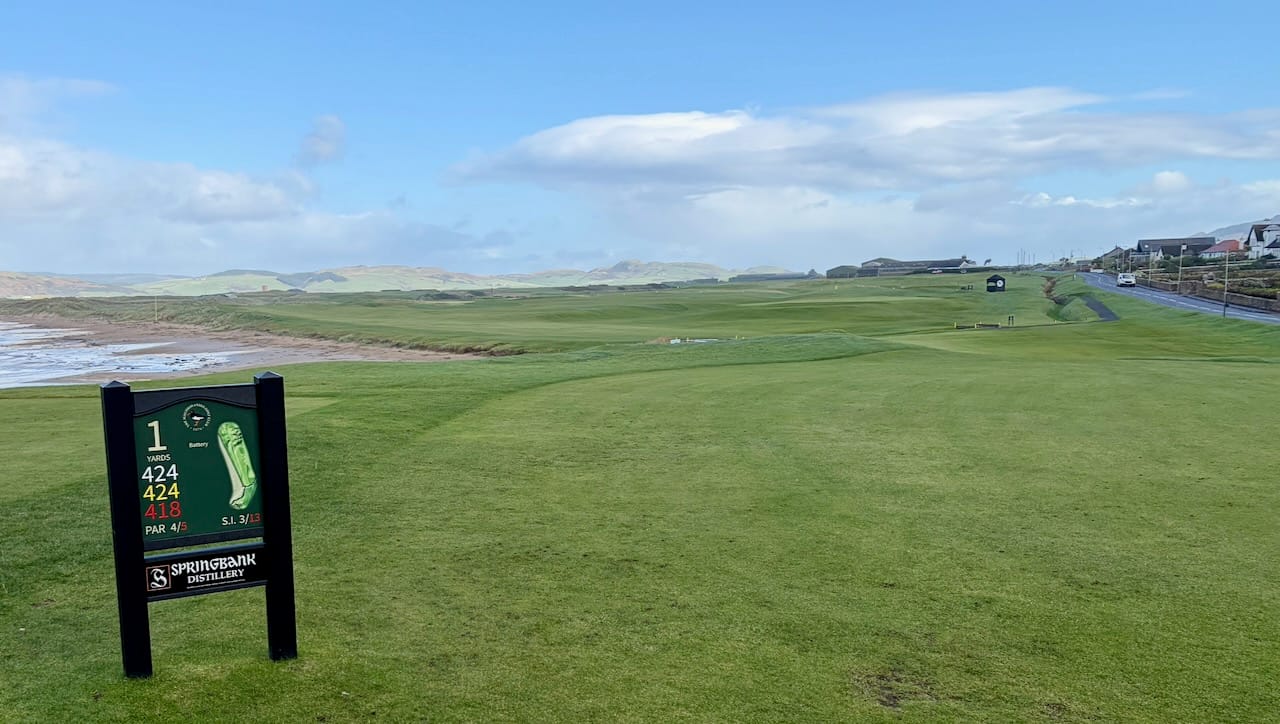
The course is located in the town of Machrihanish and was built in 1876 (150 years ago!). It is not well known because it is discouragingly remote. Like so many of Scotland's treasured golf courses, it was laid out by Old Tom Morris and has many of the features that are common to his courses: marvellous views, surprises, some blind shots and invisible bunkers and burns, and it makes great use of the sandy dunes that are near the ocean shore. It was built long before bulldozers and mechanical equipment, so the holes roll and wander through the dunes. You will not find a more beautiful golf course in Scotland. The first hole (shown above) requires you to hit across a stretch of beach or ocean, depending on the tide. It is possible, I learned, to play your second shot from the beach.

From there it was back to Ayrshire, on the west coast about a half hour outside of Glasgow. The photo above shows our group on the first tee at Prestwick wearing some, but not all, of the clothing we would soon need. This photo was taken just before we played in perhaps the worst weather I have ever tried to play golf in - bitterly cold, winds gusting from 50 to 80 kph and periodically driving, punishing, painful sideways rain that felt more like sleet. In order to tie a shoe that had come untied, I was forced to find shelter beside a wooden retaining wall because it was impossible to bend over to tie the shoe without being blown over. I knew it was bad when I saw the Scots walking in from the course, headed for the clubhouse. Though I walked the full 18 holes, I did not play the final 3 holes: having lost 3 golf balls on 3 consecutive shots because neither I nor my fellow players could see where the wind had taken my shots, I decided that posting a score was less important than preserving the few golf balls I had left.
The next day we played a course called Western Gailes. The name should have been a clue. The course was unexpectedly delightful - memorable holes hard by the ocean just a bit up the coast from Royal Troon and Prestwick. It has replaced Prestwick as one of my top 5 courses. The wind was fierce this day (we were warned!) but the first 4 holes play downwind, so you are feeling a little smug when you turn around and play the next 9 holes directly into the wind. Thankfully the final 5 holes are downwind again - by the time you get back to the clubhouse you have nearly forgotten the beating you took for the better part of 2 hours. The course is impressive enough to make forgetting possible.
After a day of recovery and a sightseeing trip by train into Glasgow, we had two days at Royal Troon. Since my last visit to this part of Scotland, Bob has become an international member of the course, which gave us opportunities we would never have had but for his generosity and hospitality. We played the course twice, once in what I came to think of as a relatively modest wind, 10 to 20 kph, and once in highly unusual Scottish conditions: dead calm, with a touch of early morning frost. On that occasion Bob had arranged for us to play a match with 4 Scots who were also members of the Club, followed by lunch, in jackets and ties, in the member's dining room. The match was halved, by which I mean that Bob and I lost our match while Greg and Grant thankfully won their match to salvage our national reputation. The competition was friendly, the company was enjoyable and the weather was stunningly, unusually pleasant.

The following day, our last in Scotland, we travelled back to Edinburgh to play another highly regarded seaside course just southeast of the city, called North Berwick (the "w" is silent, don't ask me why), looking across the Firth of Forth towards Fife and St. Andrews. Once again it was a dead calm day, which brought out the Sunday walkers, who cross the course on their way to the beach mostly oblivious to the dangers they faced from all directions.
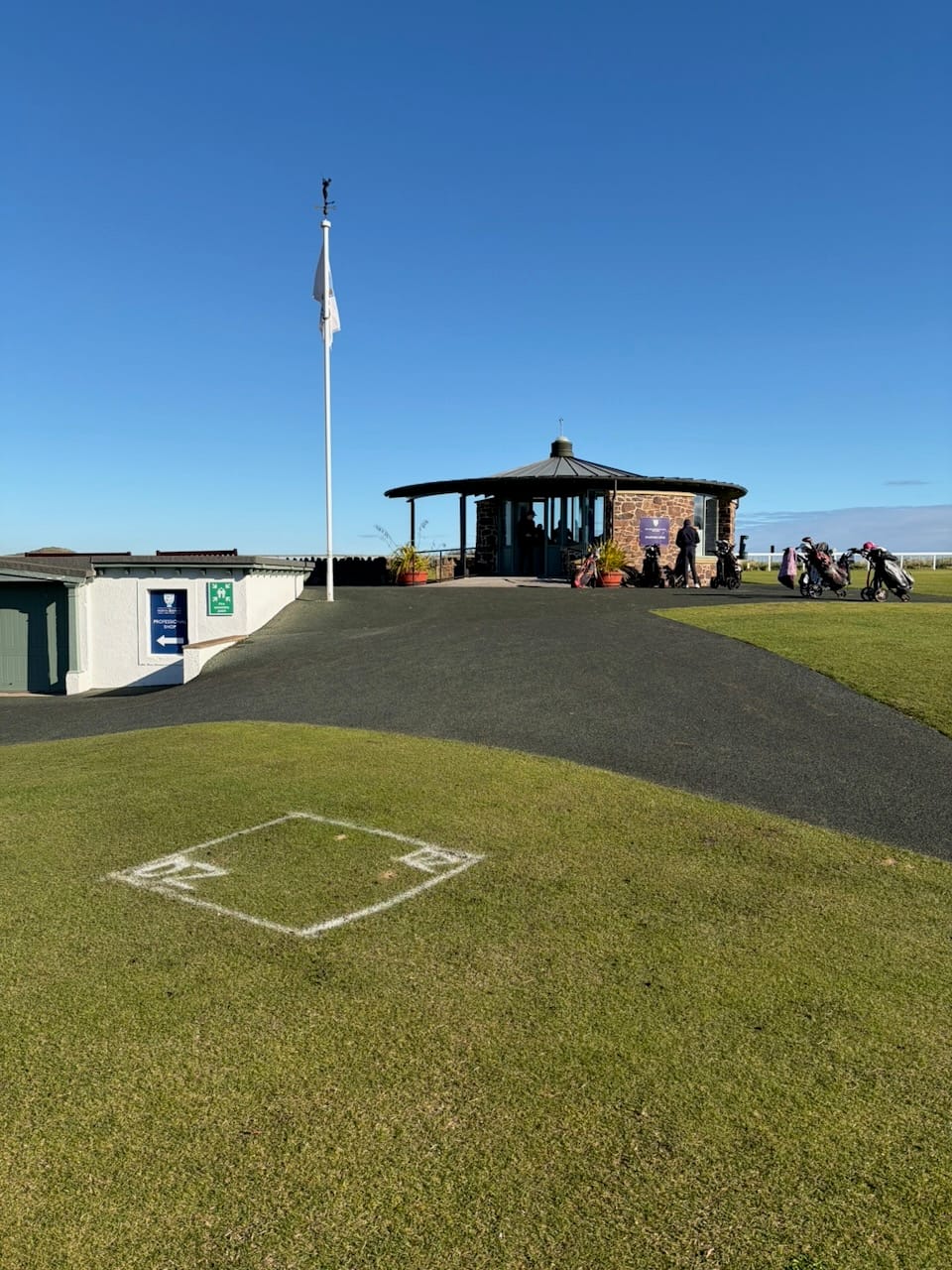
It was my good fortune to enjoy 8 or 9 days of extraordinary golf with good friends on courses that are renowned for their history, beauty and challenge.
As we traversed the country I was reminded by names of the towns of our connection to Scotland: there is Ardrossan, there's Barrhead, Westloch, Erskine and Banff. My conclusion, after studying the menus of many restaurants in different parts of Scotland, is that haggis, in its many forms, is not on the menu because tourists demand it. It is there because the Scots, for reasons that are not clear, actually like it. They order it frequently, dead sober and without any obvious signs of coercion. It is truly one of the mysteries of the Celtic world. I also concluded that my relatively mild hearing loss made understanding the average Scot virtually impossible. Even Google Translate would return the "shrug" emoji rather than trying to decipher what was being said. But despite the weather they suffer, they are a cheerful and proud people who are not easily discouraged by a wee breeze.